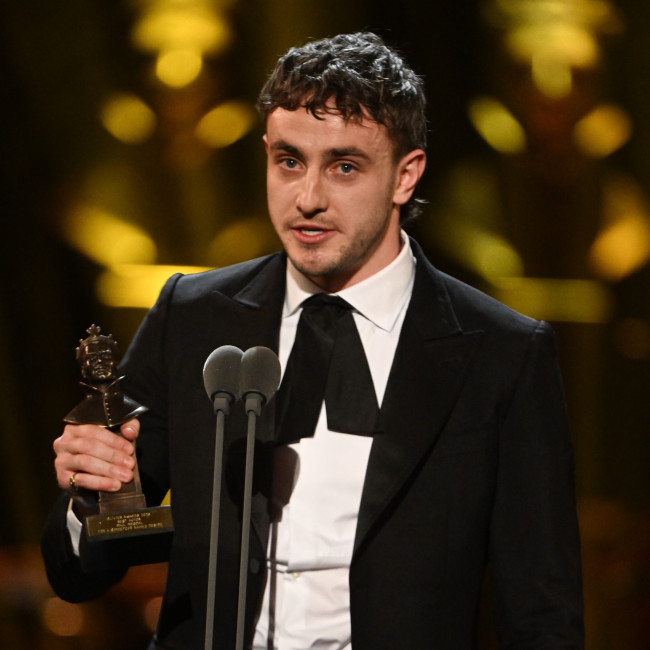
Paul Mescal says Hamnet’s ending shows the impact of grief and the visually striking image of William Shakespeare covered in cracking clay at the end helps to portray this.
Paul Mescal says Hamnet’s ending shows the impact of grief.
Mescal, 29, stars in Chloe Zhao’s Hamnet – which tells the story of the playwright’s marriage to Agnes Hathaway (Jessie Buckley) and how the devastating loss of their son Hamnet inspired Hamlet – and Paul opened up about portraying Shakespeare’s sense of loss.
He told Variety: “I didn’t think about navigating it from, like, love to grief. I think I looked at it as analysing somebody’s life.
“I was excited by the fact that I would get to show a lot of colours in terms of that, and the more that we could really make an audience feel these two people were madly in love with each other, the more that we would feel the loss of their connection in the middle act and the final act a little bit.”
Towards the end of the play, Hamlet opens on stage in London with Shakespeare playing the ghost and costume designer Malgosia Turzanska made the visually striking choice to dress him in linens – historically used to bury the dead – covered in clay.
Paul said: “It was exciting to me, because I could see how it might feel to an audience to jump into the end when you’re covered in clay. Visually, we see cracks in his face.
“We see how present Agnes’ grief is with the children because, ultimately, she’s at home with them for the vast majority of the film. And that’s really Will’s opportunity with an audience – to let them in, to see the cost of the loss of Hamnet and the impact that it has had on him.”
Paul previously said he knew that the acclaimed movie was special the first time he watched it.
Asked when he realised the flick’s potential, he told Collider: “I think when I started rehearsing with Jessie, before we started shooting.
“I’d had read the script, so I was aware that the ceiling for what the film could be, to my mind, was pretty high.
“I wanted to go into the weeds with, I think, one of the great actors of our time and one of the great directors of our time with this material. This was something that I felt could have been, and was, an extraordinary experience.
“Then, watching it for the first time in a studio space in London, I was like, ‘Oh, this is the film that I felt like we were making. This is the film we made’, which I don’t think is often the case. So yeah, it was pretty early days for me.”
Paul Mescal on grief in Hamnet