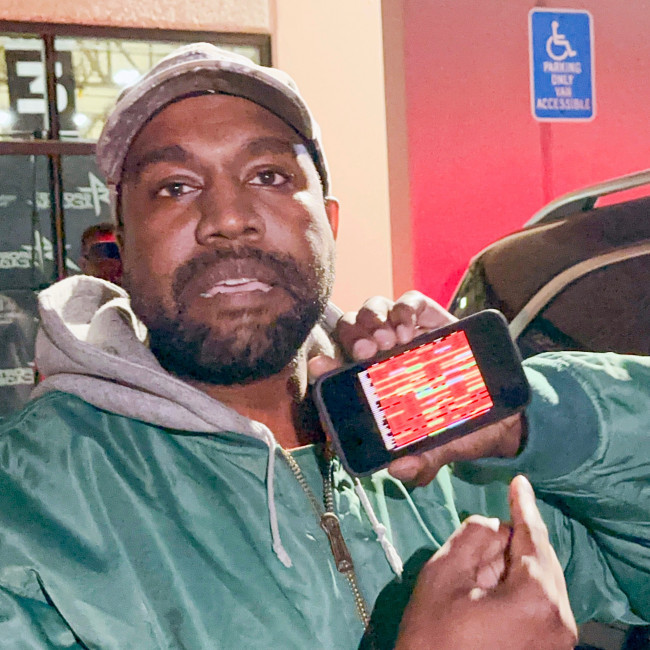
Kanye West sought treatment at a rehab clinic in Switzerland last year in an attempt to get his bipolar disorder under control.
Kanye West sought treatment at a rehab clinic in Switzerland last year.
The Stronger rapper – who came under fire last year over his controversial behaviour, including praising Adolf Hitler and selling t-shirts emblazoned with a Swastika, a notorious Nazi hate symbol – took out a full-page advertisement in the Wall Street Journal on Monday (26.01.26) to express his remorse and explain his actions were a result of a lengthy manic episode.
Kanye has now told how he has been able to get his mental health back on track after wife Bianca Censori encouraged him to make further changes to his medication.
He told Vanity Fair: “Toward the end of my four-month-long manic episode, my medication was changed. In that shift, the antipsychotic drug took me into a really deep depressive episode.
“My wife recognised that, and we sought out what’s been an effective and stabiliding course correction in my regime from a rehab facility in Switzerland. You must understand bipolar is a disease. It’s one of the most lethal nonterminal illnesses.”
But the 48-year-old rapper admitted he is still trying to work out “what works” for him when it comes to the right course of medication.
He said: “I’ve been put on and taken off of many medications. That’s just part of the journey.
“The African American community has a hypersensitivity to antipsychotic drugs, more than most groups.
“Finding the right dosage is difficult, but it’s important and critical to finding the right balance with the illness. Zombifying otherwise becomes a side effect of a high dosage. The side effects as such have been a reality for me at times.
” And it’s known that 60% to 80% of people who have to take these antipsychotic drugs experience side effects, and up to 25% of people abandon using them because of the side effects.
“I’m just trying to find what works for me so that I can continue down this positive course.”
Kanye denied speculation his apology was an attempt to improve his image so he can successfully relaunch his music career, insisting he doesn’t feel he needs any help with record sales, but he is keen to spread “love and positivity” in the future.
He said: “It’s my understanding that I was in the top 10 most listened-to artists overall in the US on Spotify in 2025, and last week and most days as well. My upcoming album, Bully, is currently one of the most anticipated pre-saves of any album on Spotify too.
“My 2007 album, Graduation, was also the most listened-to and streamed hip-hop album of 2025.
“This, for me, as evidenced by the latter, isn’t about reviving my commerciality. This is because these remorseful feelings were so heavy on my heart and weighing on my spirit.
“I owe a huge apology once again for everything that I said that hurt the Jewish and Black communities in particular. All of it went too far.
” I look at wreckage of my episode and realise that this isn’t who I am.
“As a public figure, so many people follow and listen to my every word. It’s important that they realize and understand what side of history that I want to stand on. And that is one of love and positivity.”
In his apology letter, Kanye – who has four children with ex-wife Kim Kardashian – declared himself to be “deeply mortified” by his conduct.
He wrote about his experiences of bipolar disorder: “The scariest thing about this disorder is how persuasive it is when it tells you: You don’t need help. It makes you blind, but convinced you have insight. You feel powerful, certain, unstoppable.
“I lost touch with reality. Things got worse the longer I ignored the problem. I said and did things I deeply regret.
“Some of the people I love the most, I treated the worst. You endured fear, confusion, humiliation, and the exhaustion of trying to have someone who was, at times, unrecognisable. Looking back, I became detached from my true self.
“In that fractured state, I gravitated toward the most destructive symbol I could find, the swastika, and even sold T-shirts bearing it. One of the difficult aspects of having bipolar type-1 are the disconnected moments – many of which I still cannot recall – that led to poor judgment and reckless behaviour that oftentimes feels like an out-of-body-experience.
“I regret and am deeply mortified by my actions in that state, and am committed to accountability, treatment, and meaningful change. It does not excuse what I did though. I am not a Nazi or an antisemite. I love Jewish people.”
Kanye West sought help at Swiss rehab clinic