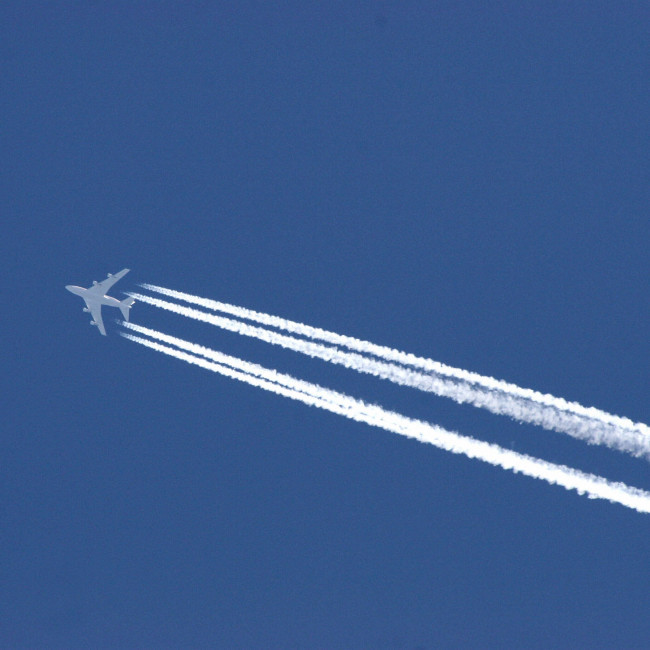
A £5 million UK trial involving Google, NATS and the Met Office will use AI to predict climate-warming contrails and help aircraft avoid them with small altitude changes.
AI will be used to help aircraft avoid forming climate-warming contrails in a new £5 million UK trial involving Google, the government, the Met Office and air traffic control provider NATS.
Operation Blue Skies will run for 30 months across Shanwick Oceanic airspace in the eastern North Atlantic, an area responsible for an estimated five per cent of global contrail warming.
Contrails form when hot aircraft exhaust meets very cold air at high altitude, creating ice crystals.
While many disappear quickly, some persist and spread into thin clouds that can trap heat in the atmosphere.
The climate impact of persistent contrails is uncertain, but research suggests it could be comparable with aviation’s carbon dioxide emissions.
The Aviation Impact Accelerator has estimated that avoiding contrails could ultimately reduce aviation’s total climate impact by up to 40 per cent.
Google will analyse satellite images, flight data and weather conditions to identify areas where persistent contrails are likely to form.
The resulting forecasts will be passed to NATS, allowing controllers to direct some aircraft around those areas.
The changes are expected to be relatively small.
In most cases, aircraft would adjust their altitude by around 2,000 feet rather than taking significantly longer routes.
Similar altitude changes are already routinely used to avoid turbulence and bad weather.
Ian Jopson, NATS’ director of sustainability, said the approach should be “pretty much business as usual” for airlines operating over the North Atlantic.
The trial will take place during selected evenings and nights in the winters of 2026-27 and 2027-28, when traffic is lower. Around 10,000 flights are expected to pass through the test area, although only a fraction are expected to require altitude changes.
The Department for Transport is providing £2.65 million, while Google is contributing £1.4 million in AI research, engineering and computing resources.
One potential problem is extra fuel use.
Flying at a less efficient altitude can increase an aircraft’s emissions, but researchers say the additional fuel burn should be small compared with the climate benefit of preventing persistent contrails.
Previous airline trials have reported reductions of around 60 per cent to 70 per cent in contrail formation or warming, according to researchers involved in the project.
Operation Blue Skies is intended to establish whether the approach can work safely at airspace scale.
Its findings will be published for wider scientific scrutiny, potentially helping determine whether AI-assisted contrail avoidance could eventually be expanded beyond the North Atlantic.
AI will try and help planes avoid climate-warming contrails