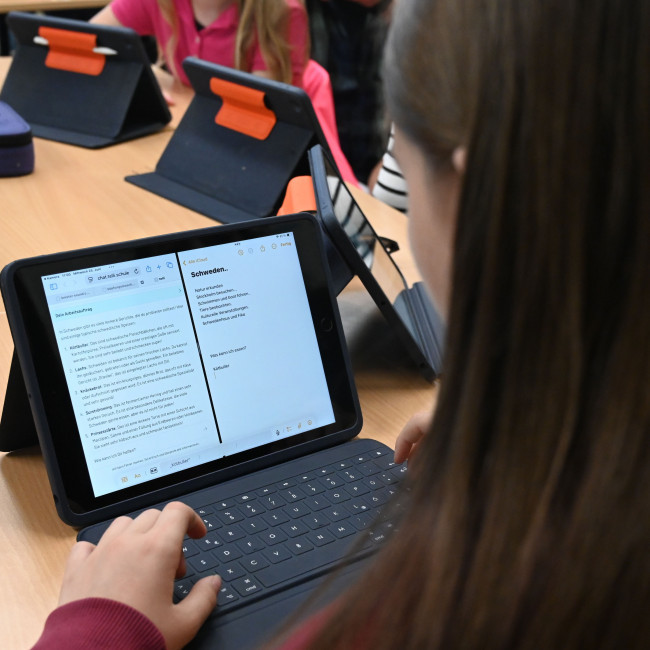
More than 150 clinicians have urged England to reduce children’s screen use in schools, warning excessive tablet and laptop use could harm “physical and developmental health”.
More than 150 clinicians have called for a reduction in the amount of time children in England spend using screens at school, warning that excessive use could damage their “physical and developmental health”.
GPs, paediatricians and other specialists have written to Education Secretary Lucy Powell and Health Secretary Yvette Cooper, arguing that tablets and laptops are being used without enough understanding of their long-term effects, including on children’s eyesight.
The clinicians said they were prescribing glasses, hearing aids and speech therapy to children “for a problem that is unintentionally being made worse in our schools”.
They claimed nearly one million children use screens during most lessons, despite research suggesting rates of short-sightedness, or myopia, are increasing among children and teenagers.
The group pointed to an analysis of 276 studies involving 5.4 million people worldwide.
It found the proportion of children and adolescents with myopia rose from about 24 per cent in 1990 to almost 36 per cent in 2023.
The condition can increase the risk of several eye diseases later in life.
The clinicians warned that some children now spend more time looking at screens during lessons than recommended for an entire 24-hour period.
They wrote: “As a country, we need to wake up to this now, and start rolling back screen use in schools before the damage compounds further.”
Dr Becky Foljambe, an NHS GP and founder of Health Professionals for Safer Screens, said parents had not been given an opportunity to “opt out” of what she described as excessive screen use in schools.
She rejected the argument that children need extensive screen exposure simply to prepare for a digital future.
She told BBC Radio 4’s Today programme: “They also need their sleep, their eyesight, they need rest, they need ability to critically think and appraise.”
The letter also warned that children with special educational needs are disproportionately directed towards screen-based learning.
School leaders stressed that technology can still be valuable when used as part of a broader teaching strategy.
Pepe Di’Iasio, general secretary of the Association of School and College Leaders, said digital tools could provide “very effective learning tools”, but should be balanced with discussion, interaction, physical education and break times.
The Department for Education said it is developing screen-time guidance for children aged five to 18 and will consult on the safety of AI and educational technology.
A spokesperson said: “Used well, technology can be a powerful tool to support learners who need it.”
The debate follows the introduction of a ban on smartphones in English schools in June.
Clinicians call for cut in school screen time for sake of children’s ‘physical and developmental health’