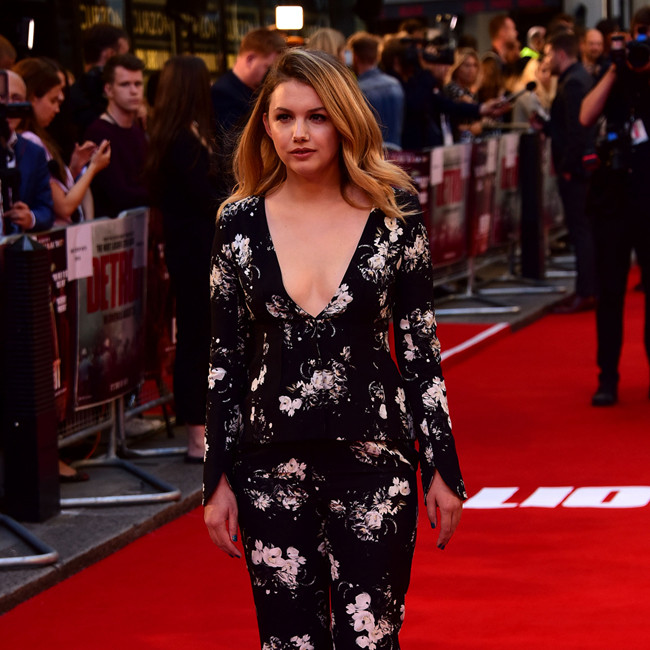
Game of Thrones star Hannah Murray has recalled how she was once told by a cult leader that she had been “possessed by a demon” and he had “performed an exorcism” on her, and she was later admitted to a psychiatric ward.
Hannah Murray has recalled a harrowing experience when she was told by a cult leader she had been “possessed by a demon” and he had “performed an exorcism” on her.
The Game of Thrones star previously enrolled in an energy-healing course in a bid to “enter a world of make-believe” and “feel like a shaman”, but she was “completely taken in” by a cult leader, who she refers to as Steve, which resulted in her being admitted to a psychiatric ward.
In an excerpt from her new memoir, The Make-Believe: A Memoir of Magic and Madness, published in The Cut magazine, Hannah writes: “I was on the last day of an energy-healing course held in the basement of a hotel in London, hours away from my initiation ceremony, when I was taken to the hospital.
“Even after I was told I was being involuntarily committed, I was not concerned.
“Steve told me I had been possessed by a demon while filming Detroit.
“He had performed an exorcism on me. So I was concerned only with the energy I could feel spiralling up through my body and the voices I could hear in my head.
“And with Steve: my King, my God, my great love and my most frequently contacted on WhatsApp.”
Steve became the “only person” Hannah “cared” communicating with, but one day Hannah “snapped” and she directed anger at Steve.
Hannah later told how she had been “completely taken in by everything he said”, adding: “I believed him. I believed he was not a cult leader. I believed everything he told me.”
After three weeks on the psychiatric ward, the former Skins star was allowed to go home.
She writes: “I was not well when I left the hospital. This is not the story of my recovery – or at least not a simple, straightforward one. I did not enter ill and leave well.
“I entered extremely psychotic and left somewhat less so.”
Hannah was referred to a psychiatrist to monitor her mental health, and she told him of her previous “drug use, heavy drinking, self harm” and her former “strong desire” to take her own life.
He concluded she had bipolar disorder.
Hannah adds: “It made sense. I was thinking about a friend’s phone call back in October, her concern about the increasing intensity of my high highs and low lows. Bipolar disorder had felt, at that point, like the unspoken words beneath her concern. I hadn’t wanted to admit then that there was anything wrong. But it was harder, in the light of recent events, to really continue to believe everything was fine.
“There was a kind of immediate relief. This could provide an explanation for many years of challenge, mental anguish, pain, confusion.”
Hannah Murray was admitted to psych ward after being ‘possessed by a demon’